

Published on: 14 July 2026
Last updated on: 14 July 2026
Collisions during bending: types, error codes and solutions
A collision during sheet metal bending occurs when the product comes into contact with a part of the press brake that it should not touch: the punch, die, upper beam, lower beam or machine frame. This means that the required bend angle cannot be achieved. The cause is almost always related to the geometry of your product, such as flanges that are too high, a bend angle that is too acute for the protruding section or multiple bends that leave too little clearance. Some collisions are immediately visible in your drawing, while others only become apparent when Sophia® simulates the bending sequence.
There are six types, each with its own cause, its own error message and its own solution.
-
Overview: all collision types
1. Collision with the tooling: the U-profile
2. Collision with the lower beam: acute angle with a long protruding section
3. Collision in a Z-bend: X-dimension too small
4. Collision in box-shaped products: height above 230 mm
5. Collision in large sheets with multiple Z-bends
6. Collision caused by lifting equipment for heavy parts
Error code 1400: what it means
Sophia® checks every bent part against six manufacturability guidelines. Guideline 6 (the U-profile checker) assesses whether a collision occurs. If our ordering platform detects a problem, error code 1400 appears on the screen, explaining what is wrong and what adjustments can be made. You can edit your file straight away and upload it again.
Not all collisions are detected immediately. A drawing error in your file may cause the manufacturability check to miss the collision. In that case, after placing your order, you will receive a manufacturability report from 247TailorSteel, detailing the collision found and the available solutions.
Overview: all types of collisions during bending
| # | Type of collision | Cause | Message |
| 1 | Tools (U-profile) | Flanges too high or too close together | Error code 1400 |
| 2 | Bottom bar | Projecting part >58 mm, angle <70° | Feasibility Report |
| 3 | Z-bend (X-measurement) | Minimum X dimension not met | Error code 1200 |
| 4 | Box shape (height) | Flanges >230 mm high | Feasibility Report |
| 5 | Large plate + multiple Z-bends | Angles <122°, pre-bending of large sheets not possible with a lifting aid | Feasibility report or error code 1700+ |
| 6 | Lifting equipment | Too many holes in the product (insufficient vacuum), surface area too small (no room for the suction cup) | Error codes 1700+ |
1. Collision with the tooling: the U-profile
This is the most common cause of collision. A U-profile has a flat central section with a flange on either side, either raised or lowered. When the second flange is bent, the section that has already been bent moves towards the punch or die. If the flange height is too great or the distance between them is too small, the product will collide with the tooling.
This can occur when:
-
Flanges that are too high for the available tool height
-
The distance between the flanges is too small for the punch to move freely
-
A combination of sheet thickness and flange height that exceeds the die’s capacity
Message on our ordering platform: error code 1400
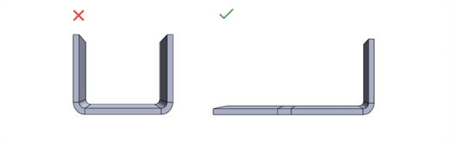
Solutions:
-
Leave the flange flat: draw the flange that causes the collision in its flat position and bend it yourself afterwards.
-
Add a manual bending line: for material up to 3 mm thick, add a perforated cutting line along the bend line. The slot width must be at least 0.8 × the sheet thickness and the spacing must be at least 1.5 mm.
-
Order the product as a flat blank: export your bent part as a DXF file, then upload the flat pattern as a DXF or DWG file and bend the product in-house.
2. Collision with the lower beam: acute angle with a long protruding section
If the protruding section of your sheet is longer than 58 mm, the bend angle must not be less than 70°. At a more acute angle, the protruding section moves upwards and collides with the lower beam of the press brake.
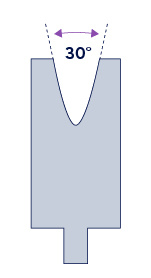
If the protruding section is 58 mm or shorter, an angle as small as 37° is possible. This is the most acute angle that the tooling can achieve when material springback is taken into account. The tooling has a minimum angle of 30°, while springback provides approximately 7° of additional allowance.
Notification in our ordering platform: error code 1400
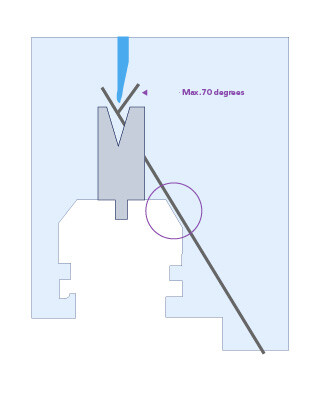
Solutions:
-
Use an angle of at least 70° if the protruding part is longer than 58 mm.
-
Shorten the protruding part to a maximum of 58 mm if a sharper angle is required.
3. Collision in a Z-bend: X-dimension too small
A Z-bend consists of two parallel bends in opposite directions, creating an S-shaped or stepped cross-section. The minimum distance between the two bend lines is known as the X-dimension. If this distance is too small, the tooling does not have enough clearance to create the first bend without touching the second bend line.
The minimum X-dimension depends on the sheet thickness and tooling. The exact values for each thickness are listed in the delivery specifications for bending.
Message on our ordering platform: error code 1200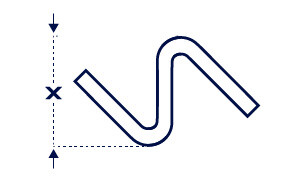
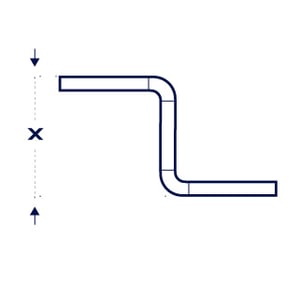
Solutions:
- Increase the X-dimension to the minimum value required for your sheet thickness. The exact values for each thickness and die opening are listed in the Minimum X-dimension for Z-bends table in the delivery specifications for bending.
4. Collision in box-shaped products: height above 230 mm
A box-shaped product, meaning a product with at least three or four bent sides, such as an enclosure or tray, requires several successive bends. Each flange that has already been bent moves with the product while the next bend is made. If the flange height exceeds 230 mm, the walls collide with the upper beam or machine frame during one of the later bends.
Above 230 mm, manufacturability at 247TailorSteel cannot be guaranteed without modifications.
Notification in our ordering platform: this is not detected during the manufacturability check. You will receive a manufacturability report.
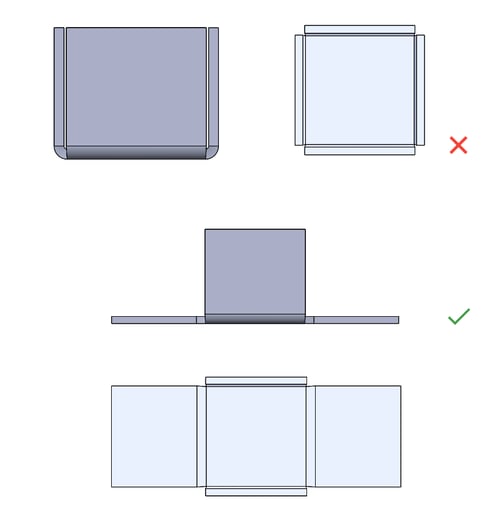
Solutions:
-
Limit the flange height to a maximum of 230 mm.
-
Divide the product into two or more separate parts that can be joined afterwards.
5. Collision in large sheets with multiple Z-bends
Large sheets with Z-bends in the centre require pre-bending before the bend can be made. This is not possible in combination with lifting equipment. In addition, the angles of these Z-bends must not be less than 122°. At a more acute angle, the sheet collides with the machine while it is being rotated between bends.
Notification in our ordering platform: manufacturability report, error code 1700 or higher

Solutions:
-
Use an angle of at least 122° for all Z-bends in this type of product.
-
Divide the product into separate parts that can be bent individually.
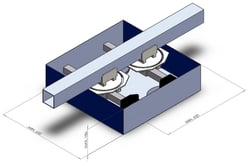
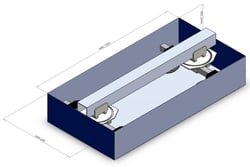
6. Collision caused by lifting equipment for heavy parts
At 247TailorSteel, bent parts weighing more than 45 kg are supported using lifting equipment. This equipment has fixed dimensions and a defined range of motion. With certain product shapes or bending sequences, the lifting equipment itself may collide with the product or tooling, making the bend impossible to perform.
This type of collision is difficult to predict from a drawing because it depends on the specific dimensions of the lifting equipment and the order of the bends. Despite the checks performed by our ordering platform, a problem may still arise when the lifting aid is positioned on your product. This is identified during the order review. In that case, you will receive a manufacturability report after placing your order.
Notification in our ordering platform: error code 1700 or higher, or you will receive a manufacturability report after placing your order.
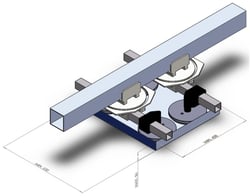
Solutions:
-
Modify the design based on the manufacturability report.
-
Reduce the weight of the product, for example by selecting a different material or adding cut-outs, so that lifting equipment is not required.
-
For more information about this type of collision, see the blog Bending heavy parts.
Error code 20000 or higher: manufacturability check unavailable
Do you see error code 20000 or higher? This means that our ordering platform cannot perform a manufacturability check, which may lead to problems when your product is processed. Carefully review your file, convert it to sheet metal again or clean up the file together with our Technical Service team. This will allow you to make full use of the manufacturability checks again.
Questions?
Do you have any questions about a collision involving your bent part, or are you unsure whether your design can be manufactured? Please contact us.
/banner_verpakkingsopties_2600x800.jpg)

/csv-import-2600x800.jpg)
/het%20verschil%20tussen%202.5D%2c%203D%20en%20XY%20Lasersnijden.jpg)