


Published on: 15 April 2026
Last updated on: 15 April 2026
Why are 304 and 304L stainless steel often listed together in a single material name?
If you regularly order 304 stainless steel sheet metal, you’ve likely come across the designation 304/304L in a material name. In this blog, we explain the difference and why they’re often mentioned together.
What is the difference between 304 stainless steel and 304L stainless steel?
Stainless steel 304 is one of the most widely used stainless steel alloys in the world and is known for its excellent corrosion-resistant properties. Stainless steel 304L is the same alloy but has a lower carbon content. Specifically, 304 contains a maximum of 0.08% carbon, while 304L contains no more than 0.03%.
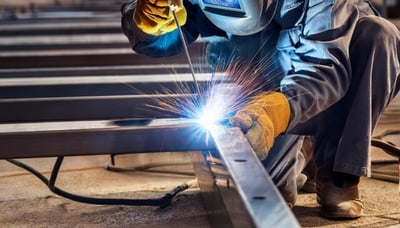 This directly explains the letter L, which stands for “Low carbon.” In other words, a low carbon content. The lower carbon content results in less chromium carbide formation and reduces the risk of intergranular corrosion after welding.
Stainless steel 304L therefore offers an advantage for welded components compared to standard 304.
What does it mean when 304/304L appears in a single material designation?
When both 304 and 304L appear in the material designation, this means the material is dual-certified. In other words, the material is a 304L, but it also meets the specifications of a 304.
In fact, a 304L always meets the specifications of a 304 (with the added benefit of being more weldable). But note: Because a 304 can contain more than 0.03% carbon, the reverse is not always true.
In general, you can use 304 and 304L interchangeably without any issues, but there are exceptions.
When does the difference between 304 and 304L stainless steel matter?
The difference between 304 and 304L does matter if, for example:
-
Specific standards have been established,
-
Exact material requirements are specified,
-
Stainless steel 304 is explicitly specified in a design.
In these cases, it is advisable to verify with a metallurgist whether 304/304L is also suitable. In doing so, particular attention must be paid to the application (environmental or operating conditions) in which the stainless steel must perform.
To illustrate, let’s look at the heat resistance of stainless steel. For welding, 304L stainless steel is better suited than 304, but the heat resistance of 304L (in clean air) is about half that of 304 stainless steel.
 Just to be clear. Welding also generates heat, but when we talk about heat resistance here, we’re referring to resistance to scaling. Heat causes thick oxides to form on the surface. Due to fluctuations between cold and hot temperatures, the oxides crumble (or flake off), eventually leading to a loss of wall thickness. Carbon provides better resistance to scaling, and 304 contains more of it.
Note: Does your material need to be easily weldable, heat-resistant, and corrosion-resistant? Then you’re better off choosing a titanium-stabilized grade, such as 304Ti (also known as 321). At relatively high temperatures (in clean air), you might even need alloys like 309 and 310.
There are a few other situations where the difference does matter. However, these are exceptions to the rule.
Do you have any questions?
Do you have any questions about 304 stainless steel and/or 304L stainless steel? Feel free to contact us. Want to be sure that 304/304L is suitable for your projects? Then consult a metallurgist.
This article was written in collaboration with MCB.
/banner_verpakkingsopties_2600x800.jpg)

/csv-import-2600x800.jpg)
/het%20verschil%20tussen%202.5D%2c%203D%20en%20XY%20Lasersnijden.jpg)